Air-Fryer Microwaves: One Box or Two? Decoded for Indian Kitchens
Air Fry, Diet Fry, SlimFry: every microwave brand now sells a fryer mode. What it really is, the ₹ maths against a standalone air fryer, and which way to buy.
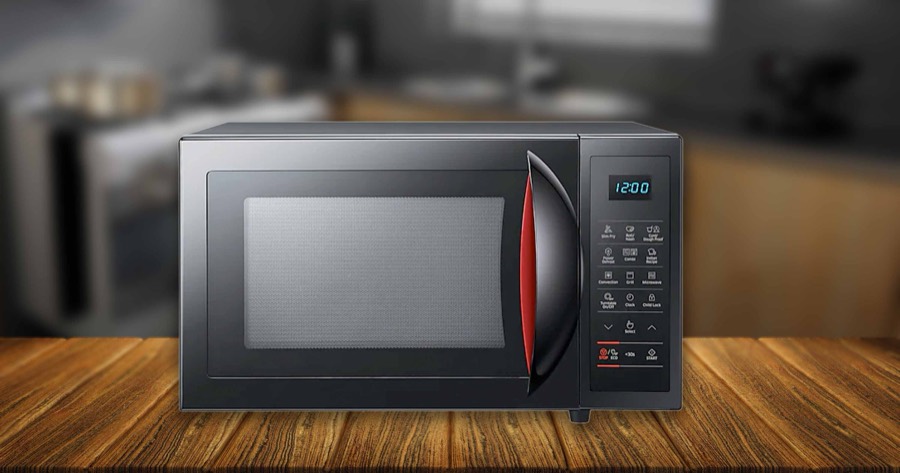
Basgo saysNeed an oven? One box. Fry daily? Two boxes.
Every microwave brand now sells a box that “air fries”. LG calls it Diet Fry, Samsung SlimFry, IFB and Midea plain Air Fry. So should you buy one machine that does both, or a microwave and a separate air fryer? Here’s what the mode actually is, and the rupee maths.
“Air fry” in a microwave, decoded
An air fryer is a small oven with a powerful fan: hot air rushes around the food and crisps it with a spoonful of oil instead of a kadhai full. A convection microwave already has the parts for that, a heating element and a fan. “Air fry” is that convection system with presets tuned for crisping, plus usually a mesh tray.
So the badge is mostly a name. Two checks before you pay for it:
- Read the spec row “Air Fry: Yes/No”, not the box art. Some convection models with fast-heating fans don’t list air fry at all.
- Check the tray is in the box. Air frying needs food to sit on a rack or mesh so air reaches all sides.
The oil claims, like “up to 88% less oil” from LG and “up to 90% less fat” from Philips’ standalone fryers, are the makers’ own tests. Real-world numbers depend on what you’re frying.
One box: what the feature costs
On IFB’s own store in October 2026, two 30-litre convection microwaves sat side by side:
- IFB 30BRC4, with Air Fry: ₹20,490
- IFB 30BRC2, without Air Fry, otherwise similar: ₹18,690
That’s ₹1,800 for air frying. Midea’s new range, launched in July 2026, puts “Healthy Air Fry” on both its convection models (24 L at ₹19,990 and 28 L at ₹22,990 MRP) with a 10-year magnetron warranty.
Two boxes: the alternative
Philips’ standalone air fryers on its Indian store:
- NA120 (4.2 L basket): ₹4,699
- NA130 (6.2 L basket): ₹6,999
The maths:
- IFB 30BRC2 + Philips NA120 = ₹23,389, which is ₹2,899 more than the 30BRC4 that does both.
- Budget route: a 20-litre solo microwave (Midea’s is ₹10,990 MRP) plus the NA120 comes to ₹15,689. That’s cheaper than Midea’s 24-litre air-fry model, but you lose baking, because a solo microwave has no convection.
When two boxes win
- You air-fry most days. A 4-litre basket heats faster than a 30-litre oven cavity, and it’s easier to clean.
- Dinner needs two things at once. One box means the dal waits while the pakoras crisp.
- You already own a working microwave. Just add an air fryer for ₹4,700–7,500.
When one box wins
- You’re buying a microwave anyway and want an oven. For about ₹1,800 more, you get baking, grilling and air frying in one footprint.
- Counter space is tight, as it is in most Indian kitchens.
“900 W”: the watts that matter for your bill
Microwave brochures lead with output power, the heat that reaches the food (800–900 W on most family models). Your electricity meter sees the input:
- LG’s 32-litre MJEN326SFW: 900 W output, 1,350 W input on microwave, up to 2,400 W in convection.
- Samsung’s 28-litre MC28A5145VK: 900 W output, 1,400 W input, up to 2,100 W in convection.
About a third of the power never reaches your food. At ₹8 a unit, a three-minute reheat costs about 55 paise, and a 30-minute convection bake at most ₹10 (the heater cycles on and off, so usually less). One practical point: in convection or air-fry mode, a microwave can draw over 2 kW. Don’t run it on the same socket strip as an induction cooktop.
Jargon on the box, decoded
- Charcoal heater (LG): its name for the heating element. There’s no charcoal.
- Inverter (LG NeoChef, IFB): the microwave runs at a steady low power instead of switching on and off, for more even defrosting. It has nothing to do with your home inverter.
- Sensor cook: stops cooking when it detects enough steam inside.
- Indian auto-cook menus: presets for dishes like rotis, curd, paneer and pasteurised milk. Check they include what you actually cook; the count of menus doesn’t matter.
- Stainless steel vs ceramic enamel cavity: both are fine. Enamel wipes clean more easily and steel resists scratches.
- Warranty: read what it covers. LG’s 10 years covers the heater parts only, Midea’s 10 years covers the magnetron, and some models carry just 12 months.
Honest verdict
If you’re buying a new microwave and want it to bake, get a convection model with air fry. At ₹1,800 extra, it’s cheap. If you already own a microwave, or would air-fry daily, buy a standalone air fryer for ₹4,700–7,500 instead. Whichever way you go, ignore the oil percentages and the menu counts: check the tray, the input watts and the warranty.
Questions people ask
Is an air-fryer microwave as good as a standalone air fryer?
It works on the same idea: hot air from a heater and fan crisping food with little oil. The microwave version saves counter space and money if you also want an oven. A standalone air fryer heats its small basket faster, and you can run it while the microwave does something else.
How much extra does air fry cost in a microwave?
Sometimes very little. On IFB's own store in October 2026, its 30-litre 30BRC4 with Air Fry was ₹20,490, and the otherwise similar 30BRC2 without it was ₹18,690. That's ₹1,800 for the feature.
How much electricity does a microwave use?
Look at the input (consumption) figure, not the output. A typical 32-litre convection model puts out 900 W but draws about 1,350 W, and up to 2,400 W in convection mode. A three-minute reheat costs about 55 paise at ₹8 a unit; a 30-minute convection bake at most about ₹10.
Should I buy a solo, grill or convection microwave?
Solo reheats, boils and steams. Grill adds a top heater for toast and tikkas. Convection adds a heater and fan, so it bakes, roasts and air-fries. If you want the microwave to actually cook, buy convection.
What size microwave does my family need?
As a rough guide, about 20 litres for one or two people, 23–28 litres for a family of three or four, and 30 litres or more if you plan to bake.