Instant vs Storage Geyser: Litres, BEE Stars and 8 Bar, Decoded
Instant or storage, 15 or 25 litres, BEE stars, 8 bar, glass-lined tanks and anode rods: what a geyser's spec sheet means, and which size your family needs.
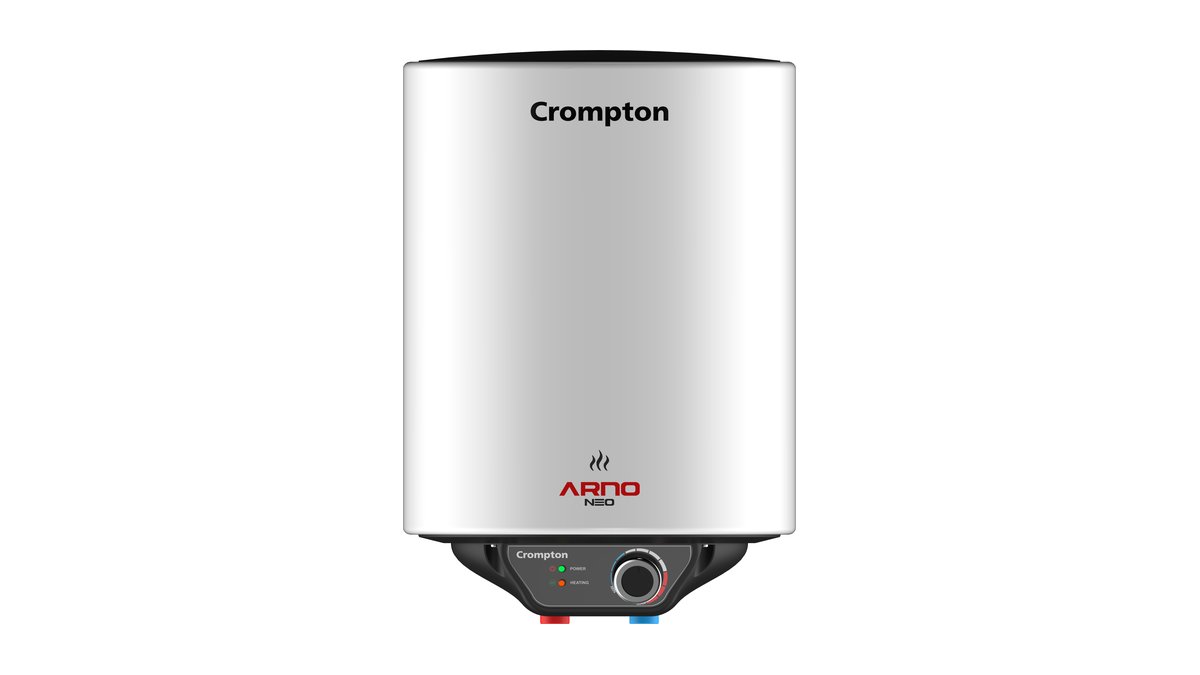
Photo: Crompton
Basgo saysBathroom? Buy storage. Check the anode yearly.
Geyser searches in India climb through November and peak in December, and every listing reads the same way: 5 Star, 8 Bar, Glassline tank, Incoloy element, rust-proof body. Here’s what each line means, which type and size suits your home, and what actually makes a geyser last.
Instant vs storage: how each works
Storage geysers (6–25 litres and more) keep an insulated tank of water hot with a 2 kW element, ready when you are. At 2 kW, a 15 litre tank heats up by 40°C in about 21 minutes and a 25 litre tank in about 35 minutes.
“Instant” geysers aren’t really instant. They’re small 1–6 litre tanks with a stronger 3 kW element (some 1–3 litre models use 4.5 kW). A 3 litre tank heats up by 40°C in about 3 minutes. Once it’s used up, though, a 3 kW heater can only keep warming about 1.7 litres a minute by 25°C. That’s fine at a kitchen sink, but not enough for a shower.
| Storage | Instant | |
|---|---|---|
| Size | 6–25 litres or more | 1–6 litres |
| Power | 2 kW | 3 kW (some 4.5 kW) |
| Ready in | 20–35 minutes | 2–5 minutes |
| Best for | Bathrooms, showers, bucket baths | Kitchen sinks, a quick wash |
| BEE star label | Yes, mandatory | No |
| Price (Oct 2026) | about ₹5,700–10,800 | about ₹2,900–3,800 |
Which size for your family
Makers’ sizing guides don’t fully agree, so here’s the middle of them:
| Use | Size |
|---|---|
| Kitchen sink | 3 litre instant |
| 1–2 people, bucket baths | 10–15 litres |
| 3–4 people, bucket baths | 15 litres, or 25 in a cold winter |
| Showers, or 5 or more people | 25 litres or more |
Orient says showers use two to three times the water of a bucket bath, which is why showers push you to 25 litres. A.O. Smith suggests going bigger where winters drop below about 15°C.
The BEE star label, decoded
The star label is mandatory for electric storage geysers from 6 to 200 litres. It measures one thing: standing loss, the electricity a full tank uses in 24 hours just to stay hot (45°C above room temperature) with no water drawn. Lower is better.
A revised star table was gazetted in December 2025 and, as reported, applies from 1 July 2026. The limits for a full day of standing loss:
| Size | 5 star | 3 star | 1 star |
|---|---|---|---|
| 15 litres | up to 0.346 kWh | up to 0.419 kWh | up to 0.507 kWh |
| 25 litres | up to 0.423 kWh | up to 0.511 kWh | up to 0.618 kWh |
What 5 stars is worth: left on all day at ₹8 a unit, a 15 litre geyser at the 5-star limit loses about ₹2.77 a day, against ₹4.06 at the 1-star limit. That’s up to about ₹1.30 a day, or roughly ₹470 a year. Switch it on only before baths, and both the loss and the saving shrink. Since most 15 and 25 litre models now sell as 5-star, take the stars, but don’t pay a big premium for them. Watch for exceptions: some 25 litre versions of popular ranges are only 4-star.
“8 bar” and pressure
The pressure rating is how much water pressure the tank is built to take. One bar is roughly a 10 metre column of water, so the taller your building, or the stronger your booster pump, the higher the pressure at your bathroom.
- 8 bar (0.8 MPa) storage geysers suit high-rises and homes with pressure pumps. Havells’ manual says to fit an extra safety (dead-weight) valve if the pressure can go above that, and not to connect the inlet directly to a water-lifting pump.
- Instant geysers are often rated around 6–6.5 bar. Racold says its valve will drip if the inlet pressure is above 1.5 bar, and recommends a pressure-reducing valve in multi-storey buildings.
Tank, element and anode: what decides how long it lasts
- Glass-lined, Glassline, “Blue Diamond”, vitreous or titanium enamel: brand names for a steel tank coated with fused glass to resist rust. Stainless steel tanks are the other route.
- “Rust-proof body”: usually means the plastic outer shell, not the tank. It’s the tank that rusts.
- Incoloy 800 element: a nickel alloy heating element that resists scaling in hard water.
- Magnesium anode rod: corrodes on purpose so the tank doesn’t. It’s the part that most decides a tank’s life. Check it every year, more often with hard water. Havells says replace it once more than 60% is used up. A rod costs roughly ₹300–800.
The safety parts, decoded
- Thermostat: switches the element on and off to hold your set temperature.
- Thermal cut-out: a backup that cuts power if the thermostat fails, at about 93°C on Havells’ models. It doesn’t reset itself, which is the point.
- Multi-function valve: releases excess pressure, stops water flowing back and lets you drain the tank. Racold says to service it every six months.
- ELCB or “shock-safe” plug: cuts power if current leaks. Havells itself warns it’s not a substitute for proper earthing.
What your wiring needs
A 2 kW storage geyser draws about 9 amps. Havells specifies a 16 A plug and a 16 A double-pole MCB, plus proper earthing. A 3 kW instant needs at least a 15 A supply, and a 4.5 kW model 20 A. Never run a geyser off an extension cord.
The ISI mark
Under a 2025 quality control order, every storage geyser, instant geyser and immersion rod sold in India must carry the BIS (ISI) mark. Check for it, especially on cheap no-name models.
Checklist before you buy
- Storage for bathrooms, instant for the kitchen.
- Size for your family: 15 litres for up to three bucket-bathers, 25 litres for showers or bigger families.
- 5 stars, without paying much extra for them.
- 8 bar if you’re in a high-rise or use a pressure pump.
- An easily replaced anode rod and an annual service.
- ISI mark, a 16 A socket and an MCB, fitted by an electrician.
Honest verdict
For a bathroom, buy a storage geyser sized for your family, and check its anode rod every year. Stars matter less than you’d think, but they’re cheap now. Instant geysers are for kitchens. See the best geysers by size and budget, and gas vs electric vs immersion rod for cost per bath and safety.
Questions people ask
Which is better, an instant or a storage geyser?
For a bathroom, a storage geyser: a 15 or 25 litre tank gives you a full bucket or a shower in one go. An 'instant' geyser is really a small 1–6 litre tank with a powerful 3 kW element. It heats in minutes but soon runs out, and then it can only warm about 1.7 litres a minute by 25°C. It suits kitchens and quick hand-washing.
What size geyser does a family of four need?
Makers' guides differ. Orient says 10–15 litres suits two or three people taking bucket baths and showers need 25 litres or more; Crompton suggests 15 litres for three people and 25 for six. For a family of four, 25 litres is the safer choice, especially with showers or a cold north Indian winter.
Is a 5-star geyser worth it?
Stars measure only standing loss, the electricity used to keep a full tank hot. Left on all day, a 5-star 15 litre geyser can save up to about ₹1.30 a day over a 1-star one at ₹8 a unit, roughly ₹470 a year. If you switch it on only before baths, the saving is much smaller. Most 15 and 25 litre models now sell as 5-star anyway, so it rarely costs extra.
What does 8 bar mean on a geyser?
It's the water pressure the tank is built to take. One bar is roughly the push of a 10 metre column of water, so tall buildings and booster pumps can exceed 6 bar. In a high-rise or with a pressure pump, choose an 8 bar model, and fit a pressure-reducing valve if your plumber advises one. Havells' manual says not to connect the inlet directly to a water-lifting pump.
How often should a geyser's anode rod be replaced?
Check it every year, and more often with hard water. Havells says to replace it once more than 60% is used up; Racold makes a yearly check a warranty condition on some models and replaces the rod once it's under 7 mm thick. A replacement rod costs roughly ₹300–800.
Do instant geysers have a BEE star rating?
No. BEE's mandatory star label covers electric storage water heaters from 6 to 200 litres. Smaller instant geysers don't carry one, but like all geysers they must carry the BIS (ISI) mark.